
Aug 19, 2026
👁️399 views
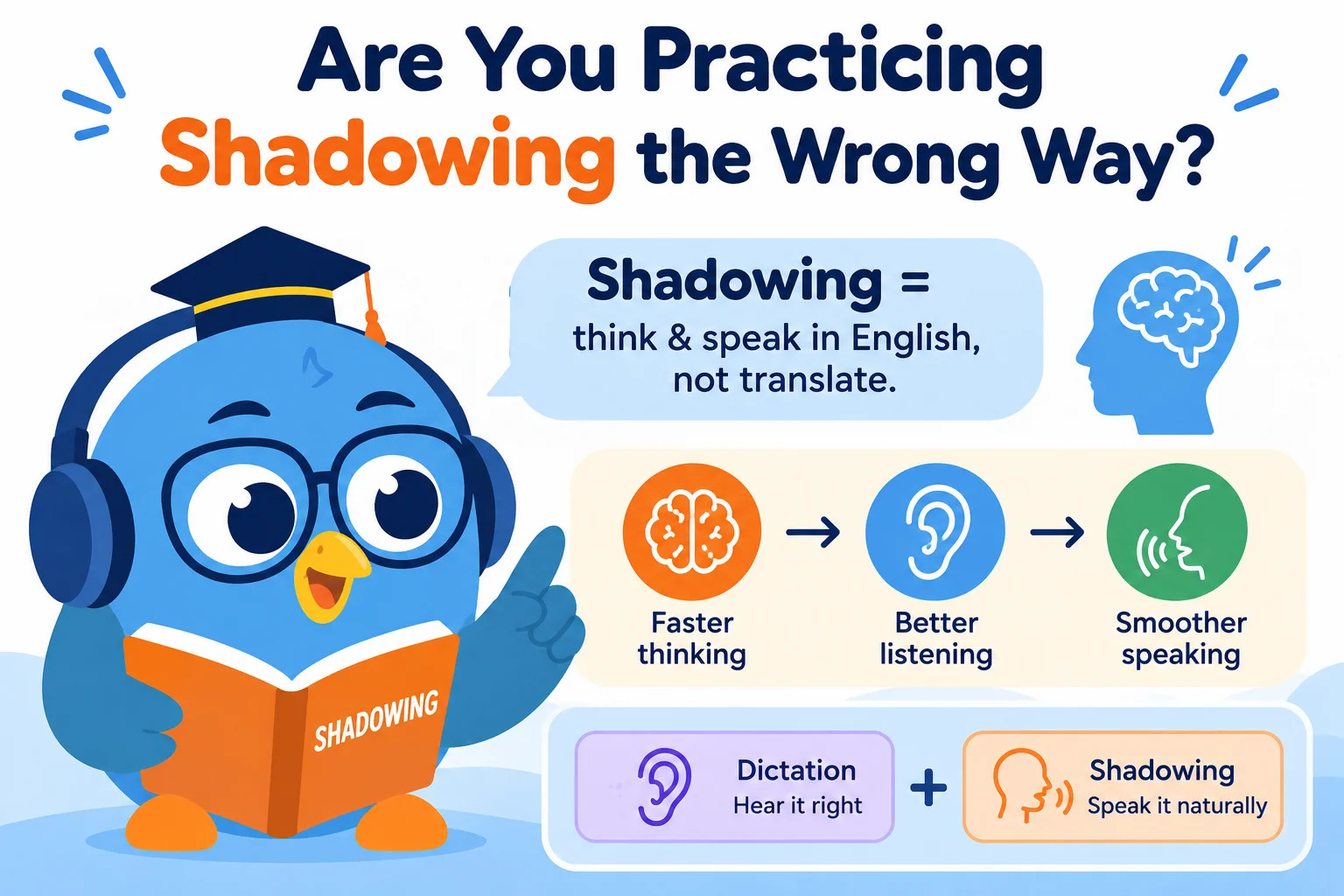
A deeply comprehensive, step-by-step masterclass on the Shadowing Technique. Learn the science, the exact routine, and the best resources to achieve native-level English fluency.
Have you ever found yourself perfectly understanding an English movie, easily reading a complex English novel, or flawlessly passing a written grammar test, only to completely freeze when it's your turn to speak?
You open your mouth, but the words refuse to come out. Your pronunciation feels awkward, your rhythm is off, and you end up translating sentences in your head, creating painful pauses in the conversation.
If this sounds familiar, you are experiencing the classic "Input-Output Gap." You have incredible passive English skills (listening and reading), but your active English skills (speaking) are lagging behind.
How do you bridge this massive gap? The answer lies in a powerful, scientifically-backed linguistic exercise known as the Shadowing Technique.
In this comprehensive 5000-word masterclass, we will dive deep into exactly what shadowing is, the neuroscience behind why it works, a detailed step-by-step breakdown of how to perform it flawlessly, the most common mistakes to avoid, and the ultimate list of resources (including YouTube channels and podcasts) to get you started today.
The shadowing technique is an advanced language learning exercise where you listen to a piece of audio in your target language and repeat what you hear almost simultaneously, like a shadow closely following a person.
Unlike standard "listen-and-repeat" exercises—where you wait for the speaker to finish a complete sentence before you speak—shadowing requires you to start speaking while the original speaker is still talking. You maintain a delay of roughly a fraction of a second (about half a second to one full second) behind the native speaker.
The technique was popularized in the polyglot community by Professor Alexander Argüelles, a world-renowned linguist who is known to be proficient in over 50 languages. Professor Argüelles discovered that passive listening wasn't enough to achieve native-like fluency. The vocal tract needed to be physically trained to produce foreign sounds at a natural speed.
He developed "Shadowing" as a kinetic, physical exercise. He often recommends shadowing while walking briskly outside, enforcing good posture and deep breathing, which forces the learner to speak loudly and clearly.
It is crucial to understand the difference between shadowing and repeating:
Why does simply parroting a native speaker yield such incredible results? The secret lies in how the human brain processes language and motor functions.
Speaking is a highly physical act. It requires the precise coordination of your diaphragm, vocal cords, lips, tongue, jaw, and soft palate. Every language requires a unique set of muscle movements. Your native language has permanently wired your mouth muscles to move in a specific way. When you try to speak English, your mouth naturally wants to use its native movements, resulting in an "accent." Shadowing is a physical workout. By forcing your mouth to keep pace with a native speaker, you are stretching and training your articulatory muscles to adopt English-specific movements. Over time, this builds muscle memory, completely eliminating native-language interference.
Prosody is the "music" of a language. In English, prosody is arguably more important than perfect grammar. English is a "stress-timed" language, meaning some words (content words) are said loudly and clearly, while others (function words) are shrunk down and spoken rapidly. For example, the sentence "I am going to the store" is rarely pronounced perfectly. A native speaker says "I'm goin' ta th' store." Textbooks do not teach this. Traditional language classes do not teach this. Shadowing forces you to mimic this rhythm. You intuitively learn how to link words, when to pause, and which syllables to stress.
When you shadow at full speed, your brain simply does not have the processing time to translate the English words into your native language. You are forced to process English as English. This helps permanently destroy the habit of mental translation, allowing you to eventually think and dream directly in English.
Neurologically, humans learn through imitation. When we watch or listen to someone perform an action, "mirror neurons" in our brain light up as if we were performing the action ourselves. By actively mirroring the speech of a native speaker, we heavily stimulate these neurons, forging strong neural pathways in the Broca's area (the region of the brain responsible for speech production).
If you are a beginner, jumping straight into simultaneous shadowing can be incredibly frustrating and overwhelming. To succeed, you must build up to it gradually.
Here is the ultimate, progressive 6-step framework to master shadowing, adapted from Professor Argüelles' original methodology.
The foundation of effective shadowing is selecting the right audio.
Do not look at the text yet. Do not attempt to speak. Put your headphones on. Close your eyes. Play the 2-minute audio clip 3 to 4 times on a continuous loop. Your goal here is strictly auditory comprehension. Try to grasp the overall context of what the speaker is talking about. Pay deep attention to the emotion in their voice, where their voice rises, where it falls, and where they take deep breaths. Let the music of the language wash over you.
Still do not speak. Open your transcript or turn on the subtitles. Play the audio again. As the speaker talks, follow along with your eyes, reading the text exactly as the speaker says it. During this phase, your brain is connecting the auditory sounds you heard in Step 2 with the visual representation of the words. You will likely notice words that you know visually, but didn't recognize auditorily because of how the native speaker "swallowed" or linked the syllables. Do this 2 or 3 times until you comfortably understand the text.
Now, you speak. Keep the transcript in front of you. Hit play on the audio. Immediately as the speaker begins talking, you begin talking aloud, reading from the text, trying to perfectly synchronize your voice with theirs.
Repeat this phase 5 to 10 times. With each iteration, your tongue will trip less, and the flow will feel smoother.
Put the text away. Turn off the screen. Hide the transcript. Close your eyes. Hit play. Now, you must listen to the audio and repeat what you hear with a half-second delay, relying entirely on your ears and your articulatory muscle memory. This is true shadowing. At this point, your brain will enter a "flow state." You won't be reading; you will be instinctively reacting to sound waves. This is where massive improvements in fluency occur. Do this until you can shadow the entire 2-minute clip with 90% accuracy.
Take your headphones, put the audio on your phone, and go for a walk outside in a park or an empty street. Walk at a brisk, marching pace. Keep your chest open, your posture straight, and take deep breaths. As you walk, do pure "blind" shadowing. The physical act of walking prevents you from tensing up, forces proper diaphragmatic breathing, and firmly anchors the language into your physical body rather than just your mind.
Many students try shadowing for a week, see no results, and quit. Almost always, this is because they are committing one of these five fatal errors.
If you try to shadow an intense, rapid-fire Eminem interview or a highly technical legal podcast as a beginner, you will fail. The cognitive load will be too high. You will constantly stumble, get frustrated, and quit. The Fix: Always start with "Comprehensible Input." Choose audio where you already understand 80% to 90% of the vocabulary. The goal of shadowing is fluency and pronunciation, not learning new complex words.
Shadowing is about flow. It is about momentum. If you pause the track every time you mispronounce a word, you completely break the rhythm and turn the exercise into analytical torture. The Fix: Accept that you will make mistakes. Your tongue will tie itself in knots. When it happens, swallow your pride, leave the missed word behind, jump back into the audio stream wherever the speaker currently is, and keep moving forward.
You cannot build muscle memory by whispering. Whispering uses different vocal cord mechanics than actual speaking. If you only whisper, you will still freeze up when you try to speak at full volume in a real conversation. The Fix: Speak at full, conversational volume. Project from your chest. You want to literally feel the vibrations in your throat and mouth.
If you shadow like a lifeless robot, reading the transcript in a flat, monotone voice, you are completely missing the point of the exercise. You will end up speaking English perfectly... like a robot. The Fix: Be an actor. Be highly dramatic. If the speaker laughs, you laugh. If the speaker emphasizes the word "NEVER", you must emphasize it exactly the same way. Mimic their facial expressions if you have to.
Shadowing for 3 hours on a Sunday and then doing nothing for the rest of the week will yield zero results. Muscle memory is built through frequent, brief, repetitive stimulation. The Fix: Dedicate 10 to 15 minutes to shadowing every single day. Make it a non-negotiable part of your morning routine.
Finding the perfect audio with high-quality, word-for-word transcripts can be tedious. Here is an extensively curated list of the absolute best resources on the internet for English shadowing, categorized by difficulty.
1. VOA Learning English (Voice of America)
2. Spotlight English
3. Learn English with TV Series
1. TED-Ed Animations
2. Luke’s English Podcast
3. Rachel's English (The "Ben Franklin" Exercises)
1. TED Talks (Live)
2. The Joe Rogan Experience / Lex Fridman Podcast (Clips)
3. Audiobooks (Audible)
To guarantee success, you need a structured routine. Here are three different routines you can adopt based on your schedule.
Once a week, open your laptop webcam or your phone's selfie camera. Play your shadowing audio in your headphones, and record a video of yourself shadowing the 2-minute clip completely blind. Afterward, watch your video. It will be painful, but it is the ultimate feedback loop. You will instantly notice if your mouth is moving strangely, if you look stiff, or if you sound robotic. Compare your recording to the original audio, note 2 specific things to fix, and apply them the next day.
The Shadowing Technique is not a magic pill that will make you fluent overnight. It is a grueling, exhausting, physical workout for your brain and your vocal tract. Your jaw will ache, your tongue will feel heavy, and you will feel foolish making strange noises in your room.
But if you push through the initial discomfort and commit to 15 minutes of shadowing every single day, something magical will happen within 30 to 60 days.
You will enter a conversation, and the words will simply flow out of your mouth. You won't have to search for the right pronunciation. You won't have to mentally translate. The English rhythm will have become a part of your physical muscle memory.
Stop reading about grammar. Stop passively watching Netflix. Put on your headphones, pull up a transcript, and start shadowing today. Your future fluent self will thank you.